Ambulance
Medical emergencies are unpredictable. They can happen at home, at work, on the road, or in public places. In those critical moments, panic is natural — but your response in the first 10 minutes of medical emergency can make the difference between recovery and serious complications.
Knowing what to do in medical emergency situations empowers you to act quickly, calmly, and effectively. Whether it’s a heart attack, stroke, accident, choking episode, or sudden unconsciousness, early intervention can save lives.
In this guide, we will walk you through exactly what to do before ambulance arrives, how to stabilize a patient safely, and when to rush to the the best emergency hospital in Hapur such as GS Super Speciality Hospital.
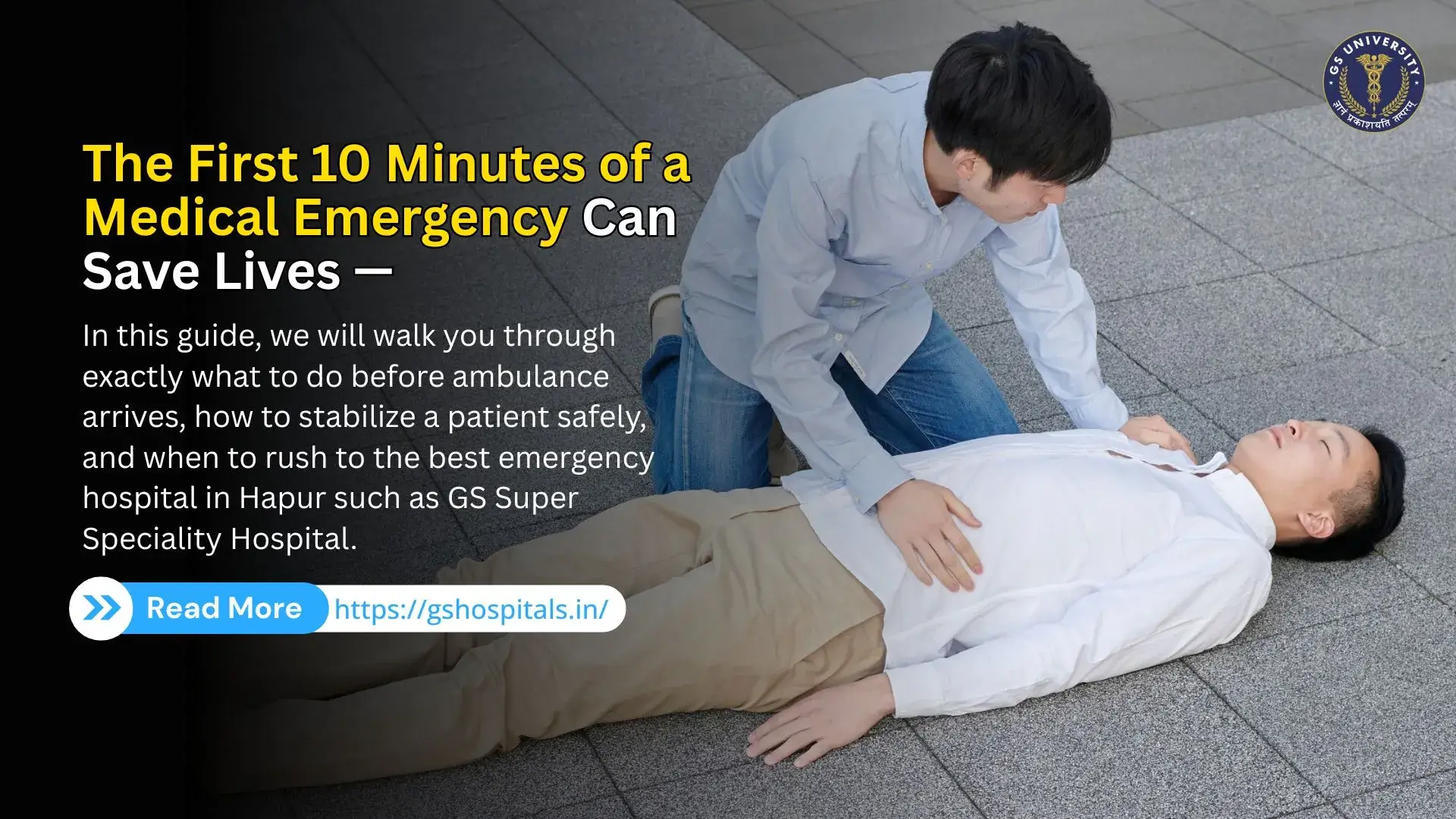
Doctors often refer to the first few minutes after a medical crisis as the “Golden Minutes.” During this period:
Brain damage can begin within 4–6 minutes without oxygen. Severe bleeding can become life-threatening in minutes. Quick, informed action improves survival rates significantly.
This is why understanding the first 10 minutes of medical emergency response is not optional — it is essential.
Your calmness is the first aid.
Take a deep breath and quickly assess:
Before helping, ensure there is no danger to you (fire, electric hazard, traffic, etc.). You cannot help effectively if you also become injured.
Call an ambulance immediately. Provide:
Immediately look for an GS Super Speciality Hospital and choose a hospital equipped with ICU, trauma care, and emergency services. In Hapur, GS Super Speciality Hospital is widely trusted for 24/7 emergency response and advanced critical care facilities.
Do not delay calling for help while trying home remedies.
This is the foundation of emergency response.
A – Airway
Ensure nothing is blocking the airway. Tilt the head back a bit and lift the chin in case of unconscious state.
B – Breathing
If not breathing, begin CPR immediately (if trained).
C – Circulation
If bleeding heavily, apply firm pressure using a clean cloth.
If the person:
Start CPR immediately.
Chest compressions:
If trained, provide rescue breaths.
Continue until medical professionals arrive.
Knowing what to do before ambulance arrives in such cases can double survival chances.
Signs:
What to do:
Take to the Best Hospital immediately, such as GS Hospital in Hapur, to ensure access to cardiac specialists.
Remember FAST:
Do not give food or water.
Keep the person lying down with head slightly elevated.
Rush to an advanced emergency center immediately.
Stroke treatment is highly time-sensitive.
Apply:
If bleeding soaks through, do not remove the cloth — add another layer and continue pressure.
If the person cannot speak or breathe:
For adults:
For infants:
If unconscious, begin CPR.
Advanced trauma care at GS Super Speciality Hospital includes surgical backup and ICU support, which is crucial for accident victims.
Knowing what to do in medical emergency situations is important — but knowing what not to do is equally critical.
Immediate professional medical intervention is essential.
Emergencies are unpredictable, but preparation reduces panic.
Keep:
If you are in Hapur, knowing the location of the best emergency hospital in Hapur like GS Hospital can save precious time.
Not all hospitals are equipped to handle critical emergencies.
A reliable emergency center should have:
GS Super Speciality Hospital is recognized as the Best Hospital in Hapur for its round-the-clock emergency response, experienced specialists, and advanced infrastructure.
When seconds matter, choosing the right hospital matters more.
Medical emergencies are frightening. Your emotional stability influences outcomes.
Your voice and confidence can stabilize the patient psychologically.
If you remember only one thing, remember this:
Act fast. Stay calm. Call for help.
The first 10 minutes of medical emergency response are not about being perfect — they are about being proactive.
Even basic actions can sustain life until professionals take over.
First, ensure safety. Call emergency services immediately. Then check airway, breathing, and circulation. Begin CPR if needed. Quick action in the first 10 minutes of medical emergency can save a life.
Stabilize the patient. Control bleeding. Keep them comfortable. Monitor breathing and consciousness. Do not give food or water if unconscious. Stay on call with emergency services if instructed.
Search for a hospital with 24/7 emergency care, ICU, trauma services, and experienced doctors. In Hapur, many patients trust the first 10 minutes of medical emergency for rapid emergency response and comprehensive care.
Brain damage can begin within 4–6 minutes without oxygen. That is why immediate CPR and emergency response are critical.
GS Hospital offers advanced emergency infrastructure, experienced specialists, cardiac and trauma care, and round-the-clock services, making it one of the most trusted names for emergency care in Hapur.
Emergencies don’t wait. Neither should you.
The difference between fear and action is knowledge. When you understand what to do in medical emergency situations and how to respond in the first 10 minutes of medical emergency, you become capable of saving lives — maybe even someone you love.
Stay prepared. Stay aware. And always choose a trusted emergency facility like GS Super Speciality Hospital when every second counts.
Because in emergencies, time isn’t just important — it’s life itself.